
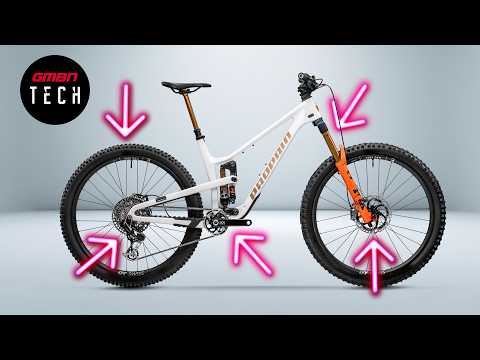
Is e-bike tech killing the mountain bike? It’s more complicated than that
The pace of change in traditional mountain bikes has slowed to a crawl while e-bikes are leaping forward. But this isn't a story of neglect; it's a story of a mature technology meeting a new one driven by a completely different industry.
There's a feeling in the air, a sentiment you hear in the workshop and on the trail. While the modern mountain bike is an objectively incredible machine, the pace of change feels… stalled. As one presenter at GMBN Tech put it, "The evolutionary changes that we've seen, well, have slowed."
Meanwhile, in the world of e-mountain bikes, the feeling is the exact opposite: "I'm not sure I've ever seen so much progression in such a short time frame."
This contrast leads to a pointed question: is the e-bike gold rush actively killing innovation in regular mountain bikes? Is all the R&D money, all the engineering talent, being siphoned off to work on motors and batteries, leaving the humble acoustic bike to stagnate?
That's not quite right. It’s not a murder, it’s a market shift. To understand it, you have to follow the money, respect the history, and recognise that the people building the future of e-bikes aren't necessarily bike people at all.
First, follow the money
Bike companies are businesses, and they invest where there’s growth. According to figures cited by GMBN, the e-mountain bike market was worth almost $6 billion in 2024, a figure that’s forecast to double by 2032.
The presenters are clear: "EMTB is the real growth part of the industry now. That's not just opinion, that is where people's money is going."
Contrast that with the traditional mountain bike market, where sales are described as "flatter, almost declining in some major markets." When you see numbers like that, the redirection of R&D budgets isn't a conspiracy; it's an inevitability.
The most exciting, and profitable, engineering problems are currently found in packaging a motor and a battery into a chassis that still rides like a great mountain bike.
The golden age of geometry is over (for now)
It’s not just about the money. The traditional mountain bike is a mature product. The period between roughly 2008 and 2018 was a whirlwind of genuinely revolutionary changes.
We saw the mainstream adoption of slacker head angles, the arrival of the first truly reliable dropper posts in 2010, the simplicity of 1x drivetrains in 2012, and the geometry revolution kicked off by concepts like Mondraker's Forward Geometry. Boost hub spacing (2015) and the crowning of the 29-inch wheel (2018) solidified the platform.
Those were tectonic shifts that fundamentally changed the shape of the bike. What have we had since? Things like the Universal Derailleur Hanger (UDH) in 2020 and SRAM’s direct-mount Transmission in 2023.
These are brilliant, meaningful improvements in robustness and serviceability, but they are refinements, not revolutions. They build upon the established long, low, and slack platform rather than tearing it up. The low-hanging fruit has been picked.
Tech companies are driving the bus
This is where the e-bike story diverges so radically. The core innovation isn't coming from traditional bike brands; it's coming from technology companies. The contrast between motor manufacturers Bosch and Avinox is a perfect case study.
Bosch, an established player, operates on a familiar, iterative cycle. Their Gen4 motor arrived in 2018, and their Drivetrain Tensioner isn't slated to be available until mid-2026. Then there’s Avinox. As GMBN notes, Avinox was "born out of DJI. That's a tech company, and they move like a tech company."
In just over two years, Avinox has reportedly released three distinct motors and a gearbox concept. This is a different world, operating at a different speed. The challenges aren't just about suspension kinematics or carbon layups; they're about thermal management, battery density, and software integration.
The software dividend
You cannot download a new head angle for your bike. You can’t get a firmware update that makes your frame 200 grams lighter. For a traditional bike, performance upgrades largely require buying new, physical hardware.
For an e-bike, that's no longer true. The ability to update software on a bike you already own is a paradigm shift. A 'Performance Upgrade 2.0' mentioned in the video claims to offer a staggering 120 Nm of torque and 600% motor support—a performance boost delivered via code.
Bosch, for instance, offers a Live Data Interface with Garmin, allowing a head unit to display motor output and battery levels. As the presenters say, "you can update that with the app. So they're improving current models quite a lot." This is the model of the tech industry, not the cycling industry: a world where the product you buy gets better over time.
A rising tide
So, is the acoustic mountain bike dead? No. It’s perfected, for now. It’s a finely honed tool that has reached a logical plateau.
The e-bike, by contrast, is a noisy, exciting, and rapidly evolving technological frontier. The good news is that the immense investment and new engineering talent flooding into the e-bike space could eventually lead to trickle-down benefits for all bikes.
This could mean more robust bearings, integrated gearboxes, and smarter electronics. A rising tide lifts all boats.
For now, the paths have diverged. The acoustic bike is in a period of quiet refinement, while the e-bike is in its loud, chaotic, and thrilling adolescence. Don't mourn the old pace of change; watch the new one and wonder what it will bring back to the rest of us.
The most exciting, and profitable, engineering problems are currently found in packaging a motor and a battery into a chassis that still rides like a great mountain bike.
You cannot download a new head angle for your bike. You can’t get a firmware update that makes your frame 200 grams lighter.
The acoustic bike is in a period of quiet refinement, while the e-bike is in its loud, chaotic, and thrilling adolescence.