
Your MTB geometry chart is a lie
The numbers on a brand's website are a starting point, not the whole story. We break down what the key figures actually mean, and why your bike's real geometry is constantly changing on the trail.
A recent video from GMBN Tech opened with a familiar tale from the workshop. A presenter had swapped a stem, a seemingly tiny change of just 15 mm, and declared that it "has changed the whole bike."
It wasn't a minor tweak; he described feeling more integrated and confident, as if the fork was working better. He felt like he was "in the bike, not on the bike."
This gets to the heart of a common misunderstanding. We obsess over geometry charts, comparing head angles to a tenth of a degree, but as the GMBN team points out, "People treat geometry charts like gospel, but... one number alone doesn't tell you anything."
The truth is that a bike's geometry is a dynamic, interconnected system, not a static list of ingredients. The bike you ride is never the same as the one on paper.
The static numbers: your bike on paper
First, let's define our terms. A geometry chart describes an unweighted bike, sitting perfectly level in a design studio. These are the baseline figures that dictate the bike's essential character.
Steering geometry (head angle, offset, and trail): The most talked-about number is often the head tube angle, the angle of the steering tube relative to the ground. Slacker angles (lower numbers, say 64.8°) are common on enduro and downhill bikes for stability at speed, while steeper angles are found on XC bikes for quicker handling.
But the head angle is only part of the story. The fork offset is the distance the front axle sits ahead of the steering axis. These two numbers combine to create trail, which GMBN defines as "the gap between where the steering axis meets the ground and the tyre contact patch."
Think of trail like the caster wheel on a shopping trolley; it's what makes the wheel want to self-centre and track straight. More trail generally equals more stability at speed, while less trail makes for faster, more nimble steering.
Chassis dimensions (wheelbase, chainstays, and BB height): The wheelbase is the horizontal measurement from the front axle to the rear axle. As the presenters note, a longer wheelbase adds stability, while a shorter one makes a bike feel more "playful and snappy." This is heavily influenced by chainstay length (or rear centre), the distance from the bottom bracket to the rear axle.
Finally, bottom bracket (BB) height—the height of the crank's centre from the ground—affects your centre of gravity. A lower BB adds stability and cornering prowess, but increases the risk of pedal strikes on technical terrain.
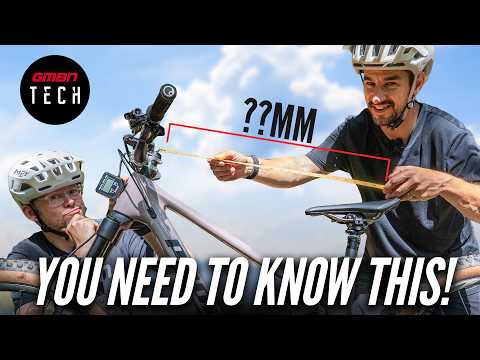
Rider fit (reach and stack): When you're standing on the pedals, the two most important numbers for fit are reach and stack. Reach is the horizontal distance from the bottom bracket to the centre of the top of the head tube; stack is the vertical distance.
These figures give you a true sense of how long and tall a bike's cockpit will feel, independent of the seat tube angle. The GMBN presenter noted his personal preference sits between 460 mm and 480 mm for reach, highlighting that this is a personal fit dimension.
The catch: your bike is never static
Here’s the crucial part. That pristine geometry chart goes out the window the second you sit on the bike. As one of the presenters put it, "When you look at the cold, hard stats on a chart, you forget that it's all moving."
On a full-suspension bike, every input from the rider and the trail changes the bike's shape. The first and most important change is sag—the amount the suspension compresses under your static weight. Your bike is designed to be ridden at its sag point, which is the true starting geometry for any ride.
From there, it's constantly in flux. When you climb a steep pitch, your weight shifts back and the rear suspension compresses further. This slackens your effective seat tube angle and shortens the bike's reach.
Under heavy braking, the fork dives, which steepens the head angle and shortens the wheelbase. This alters the bike's stability right when you need it most, which is why modern suspension kinematics are designed not just to absorb bumps, but to manage these inevitable geometric changes.
So, what does this mean for you?
Understanding that geometry is dynamic is the key to getting the most out of your bike.
First, set your sag correctly. This is non-negotiable. As the GMBN video warns, "You've got to make sure your sag's right, otherwise your head angle could be really far off, or anything else." Your entire bike's handling characteristic is predicated on starting from that correct, sagged position.
Second, think in systems, not single numbers. A bike with a very slack head angle might not feel sluggish if it has a fork with a shorter offset to keep the trail figure in check. A bike with a long reach might feel perfectly comfortable on a climb if it has a steep seat tube angle (modern bikes have pushed from ~73° to as steep as 78°) to position your hips correctly over the pedals.
Third, don't be afraid to experiment. That 15 mm stem change is a perfect example. A small adjustment to your cockpit can have a profound effect on weight distribution and handling.
Adding or removing headset spacers is another easy tweak. GMBN notes that a 10 mm spacer will shorten a bike's reach by approximately 4 mm. These small changes can be the difference between feeling like you're fighting the bike and feeling perfectly balanced within it.
The geometry chart is an essential tool for comparing the basic DNA of different bikes, but it’s not gospel. It’s the starting point for a conversation that only gets finished on the trail, with your weight, your setup, and your riding style factored in. The goal isn't to find the 'perfect' number, but to find the dynamic system that works for you.
The truth is that a bike's geometry is a dynamic, interconnected system, not a static list of ingredients.
Your bike is designed to be ridden at its sag point. That is the true starting geometry for any ride.
The goal isn't to find the 'perfect' number, but to find the dynamic system that works for you.